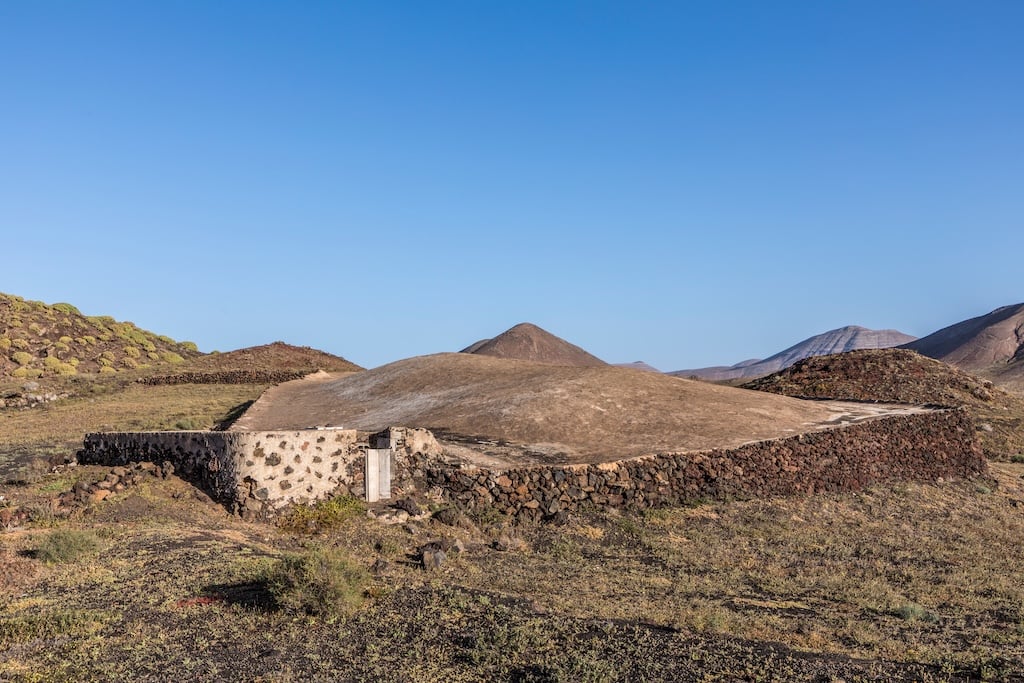
Water has always been a precious resource in the Canary Islands, and especially in Lanzarote. Unlike the greener western islands such as Tenerife or La Palma, where rainfall feeds underground aquifers accessed through wells and mountain galleries, Lanzarote has a much drier climate and very limited natural freshwater reserves.
For centuries, the inhabitants of Lanzarote relied on rainwater harvesting systems to survive in this arid environment. Houses were traditionally built with aljibes (cisterns) to collect rainwater from rooftops, while large reservoirs called maretas stored water for entire villages. These systems allowed communities to make the most of the rare rainfall the island receives each year.
However, as the island’s population grew and tourism developed during the 20th century, these traditional methods were no longer sufficient. A major turning point came in 1964, when Lanzarote installed the first seawater desalination plant in Europe. This innovation transformed water management on the island and made it possible to supply drinking water reliably despite the lack of natural freshwater sources.
Today, most of the water used in Lanzarote comes from desalinated seawater. While this technology ensures a stable water supply for residents and visitors, it also presents challenges. Desalination requires significant amounts of energy and produces concentrated brine that must be carefully managed to protect marine ecosystems.
With a growing population and millions of tourists visiting the island each year, improving water efficiency has become increasingly important. This is why many initiatives now focus on water reuse, efficiency, and sustainable water management.
Reusing Water at Home: A Simple Way to Save Resources
In the Canary Islands, the average household uses around 150 liters of drinking water per person per day, even though only about 3 liters are actually needed for drinking.
A large share of this potable water is used for activities that do not require drinking-water quality, such as toilet flushing, cleaning, garden irrigation. For example, showers and toilet flushing alone account for around 50 liters per person per day.
This means that more than 140 liters per day could potentially be replaced by reused water without affecting everyday comfort.
This is where solutions like those promoted by AguaRenace, a company focused on domestic water regeneration systems, come into play. These systems recover water from showers, sinks,bathtubs, and washing machines (greywater) and treat it so it can be reused safely for non-drinking purposes such as toilet flushing, cleaning, or watering gardens.
Supporting a More Sustainable Water Future
Living on an island like Lanzarote means that water must be managed carefully. From traditional rainwater cisterns to modern desalination plants and new water reuse technologies, the island has always had to innovate to ensure a reliable supply.
Another important challenge is the modernization of wastewater treatment plants (EDAR – Estaciones Depuradoras de Aguas Residuales). Many of these facilities were built decades ago when the island’s population and tourism levels were significantly lower. Today, with the rapid growth in visitors and new developments, upgrading and optimizing these infrastructures is becoming increasingly important.
In addition, parts of the water distribution network are aging and inefficient. In some cases, to deliver 1 liter of water to consumers, up to 2 liters must be produced, because nearly half of the water can be lost along the way due to leaks, outdated pipelines, or inefficiencies in the system.
Improving these infrastructures is therefore a key priority for the island’s water management. Technologies focused on water regeneration and advanced treatment, such as those promoted by AguaRenace, could play a role in supporting these improvements. By enhancing wastewater treatment and encouraging local reuse – both at community scale and within private properties – t is possible to reduce pressure on desalination systems while increasing the overall efficiency of the island’s water cycle.
For residents, property owners, and even holiday homes, using water more efficiently and reusing it whenever possible can help preserve Lanzarote’s limited water resources.
On an island where water does not come naturally from rivers or lakes, every drop truly counts.
Systems Designed for Homes and Villas
AguaRenace has compact systems can now be installed directly in private homes or holiday villas.
AR300 – Domestic Greywater Regeneration System
- Capacity: up to 300 liters per day
- Suitable for 1 to 4 people
- Can reduce potable water consumption by up to 45%
- Reuses water from showers, sinks, bathtubs, and washing machines.
AR600 – Domestic Greywater Regeneration System from AguaRenace
- Capacity: up to 600 liters per day
- Ideal for 5 to 8 people
- Up to 45% potable water savings
- Designed for larger homes or villas with higher water use.
Every Drop Counts.